What Is GTM Engineering?

B2B go-to-market has entered a new phase. Here is why GTM engineering matters more than ever, and how signals, AI agents, HubSpot, and Sales Navigator combine into a single scalable revenue engine.
Why GTM Engineering Matters More Than Ever
B2B go-to-market (GTM) has entered a new phase. For years, growth relied on a familiar structure: marketing generated leads, sales followed up, and operations tried to keep everything organized. Account-based marketing (ABM) existed, but it was mostly manual, sales-led, and difficult to scale.
Today, that approach no longer works. Buyers are harder to reach, attention is fragmented, and competition is higher than ever. At the same time, tools like HubSpot, LinkedIn Sales Navigator, and AI agents are evolving rapidly turning GTM into an engineering problem, not just a marketing or sales one.
This is where GTM Engineering comes in.
What Is GTM Engineering?
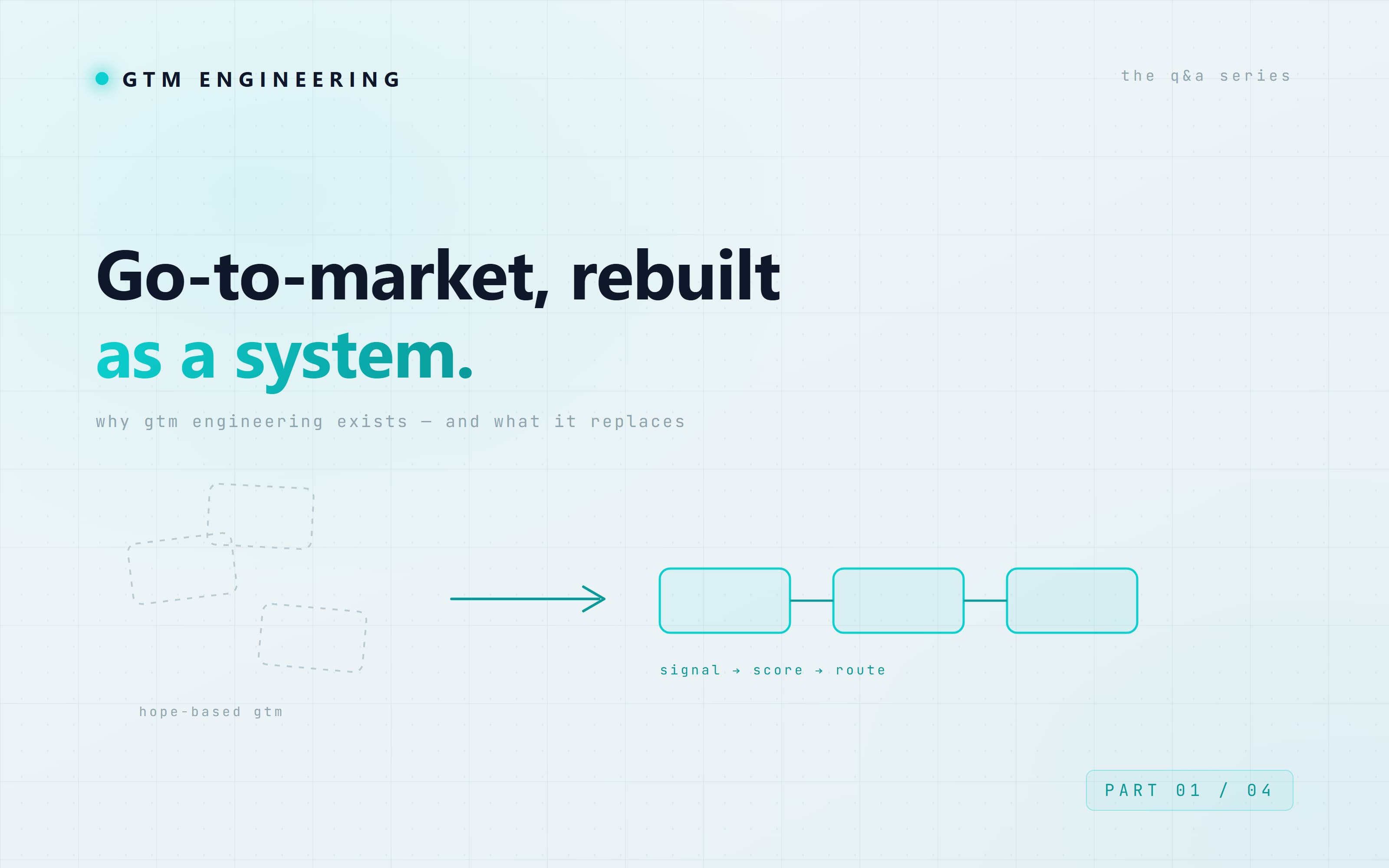
GTM engineering is the practice of designing, building, and continuously optimizing systems that connect buyer signals, data, workflows, personalization, and activation into a single, scalable revenue engine. Instead of relying on manual account selection, isolated outreach, and one-off campaigns, GTM engineering focuses on automation, intelligence, and continuous optimization.
In simple terms, it represents a shift from manually executing go-to-market tasks to architecting repeatable GTM machines that operate efficiently, adapt in real time, and improve with every interaction.
“A shift from manually executing go-to-market tasks to architecting repeatable GTM machines that adapt in real time and improve with every interaction.”
Why ABM Needed to Evolve (From ABM 1.0 to ABM 2.0)
ABM 1.0: Manual and Sales-Led. Ten years ago, ABM was a linear, headcount-bound process. It was treated purely as a sales function.
ABM 1.0: The Manual Playbook
- Download a list of companies from ZoomInfo
- Upload them into an outreach tool
- Use LinkedIn Sales Navigator to find contacts
- Send cold emails and LinkedIn messages
- Hope for replies

This process was:
- Manual
- SDR-driven
- Hard to scale
- Dependent on headcount
ABM was treated purely as a sales function.
ABM 2.0 (or ABM 2.2): System-Driven and Scalable
With GTM engineering, ABM becomes:
- A sales + marketing + RevOps function
- Automated and signal-driven
- Continuously running in the background
Instead of humans doing repetitive work, systems do the heavy lifting. This evolution is what we now call ABM 2.0 / 2.2.
Core Role of GTM Engineering in Modern ABM
As of 2025, the primary role of GTM engineering in ABM is automating account selection, prioritization, personalization, and activation at scale. Let's break this down.
Automating Account Selection (The Biggest Shift)
The Old Way. SDRs spent hours on repetitive, slow work:
- Searching LinkedIn
- Filtering companies
- Checking websites
- Manually qualifying accounts
The GTM Engineering Way. Now, account selection can be automated using AI agents, HubSpot workflows, LinkedIn Sales Navigator filters, and external APIs (Crunchbase, Apollo, etc.).

Multi-Level Qualification Flow
- Level 1: Industry & Service Fit
- Level 2: Website Keyword Validation
- Level 3: Company Size & Revenue
- Level 4: Signal Strength
Each layer improves accuracy.
Dynamic Segmentation and Lead Scoring
Once accounts enter the system, GTM engineering enables automatic segmentation and scoring. Instead of static rules, AI agents assign scores dynamically and those scores change as new signals appear.
Example Scoring Logic
Strong ICP fit
Relevant hiring activity
Website engagement
This scoring happens continuously inside HubSpot or custom systems.
Why HubSpot Is Becoming a GTM Engine
HubSpot has evolved through three phases: CRM (contact and deal management), Inbound Engine (content, SEO, email), and GTM Automation Platform (signals, workflows, AI).

- CRM: a centralized CRM that stores, manages, and unifies all customer, prospect, and account data in one place.
- Marketing automation: automate emails, campaigns, and customer journeys across multiple channels.
- Lifecycle stages: define and track lifecycle stages from lead to customer and beyond.
- Scoring and segmentation: lead and account scoring plus advanced segmentation based on behavior, intent, and attributes.
- Lists and workflows: dynamic lists and workflows to trigger actions, route leads, and orchestrate processes automatically.
- AI-powered agents: AI agents that assist with data enrichment, decision-making, and workflow optimization.
This makes HubSpot an ideal control center for GTM engineering. According to HubSpot's product roadmap, CRM platforms are increasingly becoming revenue orchestration systems rather than data storage tools [1].
Personalization at Scale Using GTM Engineering
Why Manual Personalization Doesn't Scale. Personalization used to mean writing custom emails and researching each account manually. That breaks at scale.
How GTM Engineering Solves This. With GTM engineering, personalization is conditional, AI rewrites messages dynamically, and different levels of personalization apply based on fit.
Example: Conditional Personalization
- If company matches industry + keywords → deep personalization
- If partial match → light personalization
- If weak match → generic messaging
This logic runs automatically inside workflows. McKinsey reports that B2B personalization can drive 10–15% revenue uplift when executed systematically [2].
The Personalization Payoff
Revenue uplift from systematic B2B personalization (McKinsey)
LinkedIn Sales Navigator: Buyer Intelligence Engine
Sales Navigator is no longer just a prospecting tool. It now provides:
- Buyer intelligence: analyzes professional profiles, company data, and engagement signals to help teams understand who the real decision-makers are.
- Role change alerts: notifies teams when key contacts change roles, get promoted, or move companies, creating timely engagement opportunities.
- Hiring trend insights: surfaces hiring patterns within companies, offering clues about growth, expansion, or upcoming technology and service needs.
- Committee mapping: maps buying committees by revealing reporting structures, peer relationships, and cross-functional connections inside target accounts.
- Intent-based notifications: intent-driven alerts based on profile views, content engagement, and account activity, signaling when prospects are becoming more active or receptive.

LinkedIn is also rolling out agentic features, allowing AI-driven research and alerts. According to LinkedIn, modern buying groups involve multiple stakeholders, and identifying them early improves deal success rates [3].
Lifecycle Stages: The Hidden ABM Brain
Lifecycle stages (Lead → MQL → SQL → Deal → Customer) are not just labels. In GTM engineering, they act as triggers.
Why Lifecycle Stages Matter. They control which ads are shown, which emails are sent, which SDR actions are triggered, and when deals escalate.

Example Lifecycle Triggers
- Lead → add to LinkedIn ad audience
- MQL → start outbound sequence
- SQL → notify SDR
- Deal → escalate to AE
Lifecycle stages align timing across teams, which Forrester identifies as critical for revenue efficiency [4].
Detecting In-Market Accounts (Signal-Led ABM)
"In-market" does not mean form fills. It means readiness signals. Common in-market signals include:
- Hiring procurement managers
- Visiting G2 profiles
- Funding announcements
- Technology stack changes
- Increased website engagement
Example: if a company visits your G2 page, checks pricing, and is hiring in a relevant department, that account should immediately be prioritized.
Gartner confirms that intent data can identify buying behavior weeks or months earlier than traditional leads [5].
Scaling ABM Personalization Without Scaling Headcount
The Old Scaling Model. To scale ABM you hired more SDRs, hired more BDRs, and increased costs.
The GTM Engineering Model
- One team can manage thousands of accounts.
- Personalization scales automatically.
- Human effort focuses on strategy, not execution.

This shift mirrors broader automation trends highlighted by McKinsey in revenue operations [6].
Role of AI Agents in GTM Engineering
AI agents handle:
- Account research
- Data enrichment
- Personalization rewriting
- Workflow execution
Instead of using multiple external tools, much of this can now happen inside HubSpot or connected systems. This reduces tool sprawl and operational friction.
Sales Navigator's Growing Role in B2B GTM
Sales Navigator is evolving into a buyer signal platform, a committee mapping engine, and a real-time alert system. Features include:
- New champion detection
- Role change alerts
- Intent notifications
- Multi-threading support
LinkedIn's investment in Sales Navigator reflects the growing importance of buyer intelligence in GTM [7].
Common GTM Engineering Mistakes to Avoid
Technology amplifies clarity it does not replace it. Avoid these pitfalls:
Five Mistakes That Break GTM Systems
- Automating without strategy
- Tracking too many signals
- Over-personalizing low-fit accounts
- Ignoring lifecycle alignment
- Treating tools as solutions instead of systems
“Technology amplifies clarity it does not replace it.”
Where GTM Engineering Is Headed
B2B GTM is shifting from:
- Manual → Automated
- Lead-based → Signal-based
- Sales-led → System-led
Companies that build GTM engines not just campaigns will move faster, spend less, and win earlier.
Conclusion
GTM engineering is not about replacing sales or marketing. It's about building systems that let both teams operate at a higher level.
- Signals
- AI
- HubSpot workflows
- Sales Navigator intelligence
By combining these, ABM becomes scalable, proactive, and predictable. The future of B2B growth belongs to companies that engineer their GTM not improvise it.
Engineer your GTM, don't improvise it
Ready to turn manual ABM into a signal-driven revenue engine across HubSpot, Sales Navigator, and AI agents? Let's map your GTM architecture together.

Ready to turn signals into booked pipeline?
Book a discovery call and we’ll map out how a signal-led GTM system can accelerate your revenue.