B2B GTM Using Signal-Led Growth and the Dark Funnel Strategy

How modern revenue teams find demand before buyers raise their hand — by reading the buying signals that never reach your CRM and engaging the invisible 95% with precision.
Why Traditional B2B GTM Is No Longer Enough
For decades, B2B go-to-market (GTM) followed a familiar structure. Marketing teams created awareness. Leads flowed into the CRM. Sales teams followed up. Revenue followed — at least in theory.
That model worked when buyers relied heavily on Google, when sales controlled access to information, when funnels were mostly linear, and when competition was lower. That world no longer exists.
Today's B2B buyers are fundamentally different. They are:
- More independent
- More informed
- More skeptical of outbound messaging
- Less willing to talk to sales early
Research from Gartner shows that B2B buyers now spend only 17% of their total buying time engaging with potential vendors — and that time is split across multiple suppliers. At the same time, studies consistently show that 95-98% of B2B buyers are not actively in-market at any given moment.
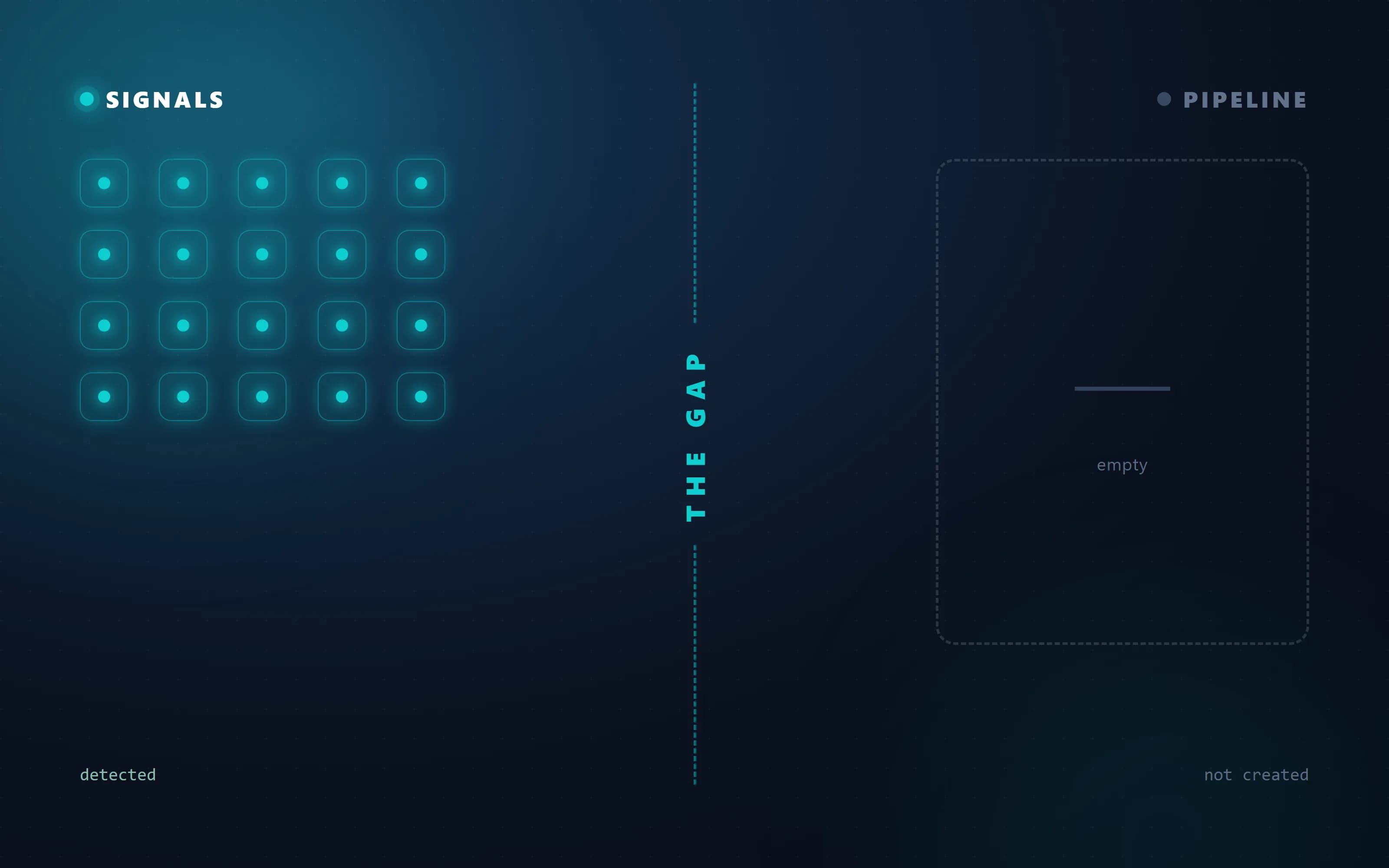
This creates a massive problem. Most GTM strategies are designed to capture the 2-5% who raise their hand while completely ignoring the other 95% who are researching quietly. That invisible majority is where modern B2B growth actually begins. This is the foundation of signal-led growth and the dark funnel strategy.
The numbers that reframe modern GTM
Of total buying time B2B buyers spend with potential vendors (Gartner)
Of B2B buyers are not actively in-market at any moment
Decision-makers involved in a typical B2B buying decision (McKinsey)

What Is the Dark Funnel?
Most B2B marketers are trained to think in funnels. Models like AIDA, inbound versus outbound, flywheels, or the familiar lead → MQL → SQL → deal flow all describe how demand is supposed to move through the system. These frameworks focus on what can be measured and attributed. This is what we call the visible funnel.
The visible funnel is made up of activities that are easy to track: paid ads, cold outreach, social campaigns, email marketing, website form fills, and demo requests. You know exactly who clicked, who converted, and who entered your CRM. Reporting is clean. Attribution feels clear.
But clarity does not equal completeness. The visible funnel mainly captures buyers who are already close to a decision. It shows you the final steps of the journey, not the full path that led there. By the time someone appears in your funnel, they've often spent weeks or months researching, comparing options, and forming opinions outside your line of sight.
That missing portion of the journey — the research, evaluation, and intent that never shows up in your dashboards — is the dark funnel.
“The visible funnel isn't wrong. It simply shows only the surface of what's really happening.”
The Critical Limitation of the Visible Funnel
The visible funnel is not where demand begins — it's where demand ends. It primarily captures buyers who are already close to making a decision: the prospects actively searching, clicking ads, filling forms, or booking demos. In most B2B markets, this group represents a very small slice of the total audience, often less than two percent.
Because this audience is so small, competition concentrates there. Every vendor targets the same keywords, the same LinkedIn audiences, and the same bottom-of-funnel intent. As more teams fight for the same buyers, costs rise — cost-per-click increases, customer acquisition becomes more expensive, and incremental growth gets harder to achieve.
This creates a structural ceiling. Even with better ads or stronger copy, teams are still competing in the most crowded, most expensive part of the market. Forrester has consistently shown that increasing competition in paid channels has driven customer acquisition costs up across B2B industries. Meanwhile, the vast majority of buyers remain completely invisible — researching, evaluating, and forming preferences outside the visible funnel.
The visible funnel doesn't fail because it's ineffective. It fails because it only shows you the final moments of a much larger buying process.
The Real Problem: The 98% You Never See
The remaining 95-98% of your market isn't filling out forms, isn't clicking ads, and isn't searching "buy software" on Google. But they still have real needs.
While they stay invisible to your dashboards, they are constantly active. They are:
- Talking on LinkedIn
- Hiring internally
- Researching competitors
- Visiting your website anonymously
- Using free or trial versions of products
- Consuming content silently
This activity lives in the dark funnel. They don't see you. You don't see them. But they are constantly emitting signals.
The Iceberg Effect: Why Your CRM Shows Only a Fraction of Reality
What most GTM teams see in their CRM is just the tip of the iceberg. Above the surface sits the visible funnel — the small, well-lit portion you already measure. Below the surface sits the dark funnel, where most of the real buying behavior happens.
Above the Surface — The Visible Funnel
- Form fills
- Demo requests
- Inbound leads
- Sales conversations


Below the Surface — The Dark Funnel
- Anonymous website visitors
- Job postings and hiring spikes
- Product usage data
- Social conversations
- Technology adoption changes
- Funding and M&A activity
McKinsey research shows that B2B buying decisions now involve 6-10 decision-makers, each independently researching information. Most of that research never reaches your CRM.
Why the Dark Funnel Matters So Much
Ignoring the dark funnel creates four major problems.
The four costs of ignoring the dark funnel
- Late engagement. By the time a buyer fills out a form, they often have already shortlisted vendors, formed internal preferences, and are validating decisions — not exploring options. LinkedIn's B2B Institute found that most buyers form preferences before ever engaging with sales.
- Hyper-competition. Everyone fights for the same bottom-of-funnel demand, driving up cost and lowering returns.
- Poor timing. Sales reach out after the buyer's mental decision is already forming, so even good outreach lands too late.
- Artificial growth ceiling. If you only capture visible demand, growth is structurally capped no matter how hard you optimize.

Introducing Signal-Led Growth
Signal-led growth is the practice of detecting demand early — and acting on it before buyers ever raise their hand.
At its core, signal-led growth means:
- Detecting early buyer intent
- Interpreting signals before form fills
- Engaging buyers at the right moment — not too early, not too late
Instead of asking "How do we get more leads?", signal-led GTM asks: "Who is showing intent right now — even if they haven't raised their hand?"
The DARK Loop Framework
To operationalize the dark funnel, signal-led GTM runs on the DARK Loop: Detect, Augment, Reach, and Kaizen (continuous improvement). This is not a one-time workflow — it is a continuous system that compounds over time.
The DARK Loop, layer by layer
- D — Detect. Identify the buying signals buyers emit across dozens of digital touchpoints long before they talk to sales.
- A — Augment. Layer context onto raw activity to turn fragments of behavior into account-level intelligence.
- R — Reach. Activate buyers with precision — relevance over volume, across the right channels.
- K — Kaizen. Continuously improve signal scoring, messaging, timing, and sequencing so performance compounds.

D — Detect: Identifying Buying Signals
Detection is the foundation of signal-led GTM. Buyers emit signals across dozens of digital touchpoints long before they talk to sales. According to Gartner, intent data can surface buying behavior weeks or months before direct engagement.
Common high-intent dark funnel signals
- Anonymous website activity. Thousands may visit your website, but only a small percentage convert. A VP of Operations who visits your pricing page three times, reads documentation, and compares integrations shows clear intent with no form fill. Using reverse IP and identity resolution, you can often identify the company, pages visited, and the frequency and depth of engagement.
- Job postings and hiring trends. Hiring is one of the strongest buying signals in B2B.
- A company hiring data engineers is likely investing in analytics
- A startup hiring RevOps roles is likely scaling systems
- A manufacturer hiring warehouse managers is likely expanding operations
- Instead of competing for talent, you can offer platforms, services, or faster and cheaper alternatives
- Outreach engagement (beyond replies). Not all intent looks like a reply. Email opens, link clicks, LinkedIn profile views, content downloads, and ad engagement all indicate curiosity even when buyers stay silent.
- Existing customer lookalikes. Your CRM is one of your most valuable assets. If 1,000 companies already buy from you, roughly 10,000 similar companies likely exist. Signal-led GTM uses firmographic similarity, technographic patterns, and behavioral data to prioritize high-probability accounts instead of random lists.
- Competitor and social listening. Buyers talk publicly about problems — feature complaints, tool comparisons, and "looking for alternatives" posts. Social listening surfaces intent before buyers ever visit your site.
- Technology adoption signals. When a company adopts a new platform — Shopify, Stripe, HubSpot, or Salesforce — it almost always triggers follow-on needs for integrations, custom workflows, add-ons, services, and optimization. A Shopify implementation signals upcoming needs around payments, analytics, fulfillment, or marketing automation; a move to HubSpot or Salesforce indicates investment in sales operations, data cleanup, reporting, or integration. Tech changes reflect internal decisions, budget allocation, and momentum — so intent is already present even before active searching begins.
- Fundraising and M&A events. New funding almost always triggers hiring, scaling, new tooling, and vendor changes. Here, timing matters more than messaging.
- Product usage data (for SaaS). Your product is a massive intent engine. Free users using paid features, trial users nearing limits, and inactive users suddenly re-engaging often outperform third-party intent data.

A — Augment: Turning Signals into Intelligence
Signals on their own are just fragments. A website visit, a job posting, or a usage spike only becomes useful when you understand who it came from and why it matters.
Augmentation is the step where context gets layered onto raw activity. Firmographic details explain what kind of company is involved. Technographic data reveals the tools they already rely on. Persona mapping clarifies who inside the organization is likely driving the behavior, while historical engagement shows whether this activity is new or part of an ongoing pattern. Together, these inputs allow intent to be evaluated at the account level rather than as isolated events.
AI plays a critical role here by resolving identity across systems — connecting anonymous website behavior, product usage, and engagement data back to real companies and decision-makers. Instead of static lead lists that age quickly, teams build living buyer profiles that update continuously as new signals appear. Augmentation is what turns noise into intelligence and makes signal-led GTM actionable.
R — Reach: Activating Buyers with Precision
Once signals are detected and enriched, activation begins — and this is where most GTM teams make mistakes. The goal is not volume. The goal is relevance.

- Personalized email tuned to the specific signal that triggered it
- LinkedIn outreach that references the buyer's real context
- Paid retargeting aimed at accounts already showing intent
- Website personalization that adapts to known visitors
- AI voice or chat agents for timely, scalable engagement
Messaging adapts based on:
- Signal type
- Buyer stage
- Persona
- Industry context
McKinsey shows that personalized B2B engagement can increase revenue by 10-15% when executed systematically.
K — Kaizen: Continuous Optimization
Kaizen means continuous improvement. Every interaction feeds back into the system — which signals convert, which messages resonate, and which channels perform best.
AI models continuously refine:
- Signal scoring
- Messaging
- Timing
- Sequencing
Over time, GTM performance compounds.
The Three-Layer GTM Playbook
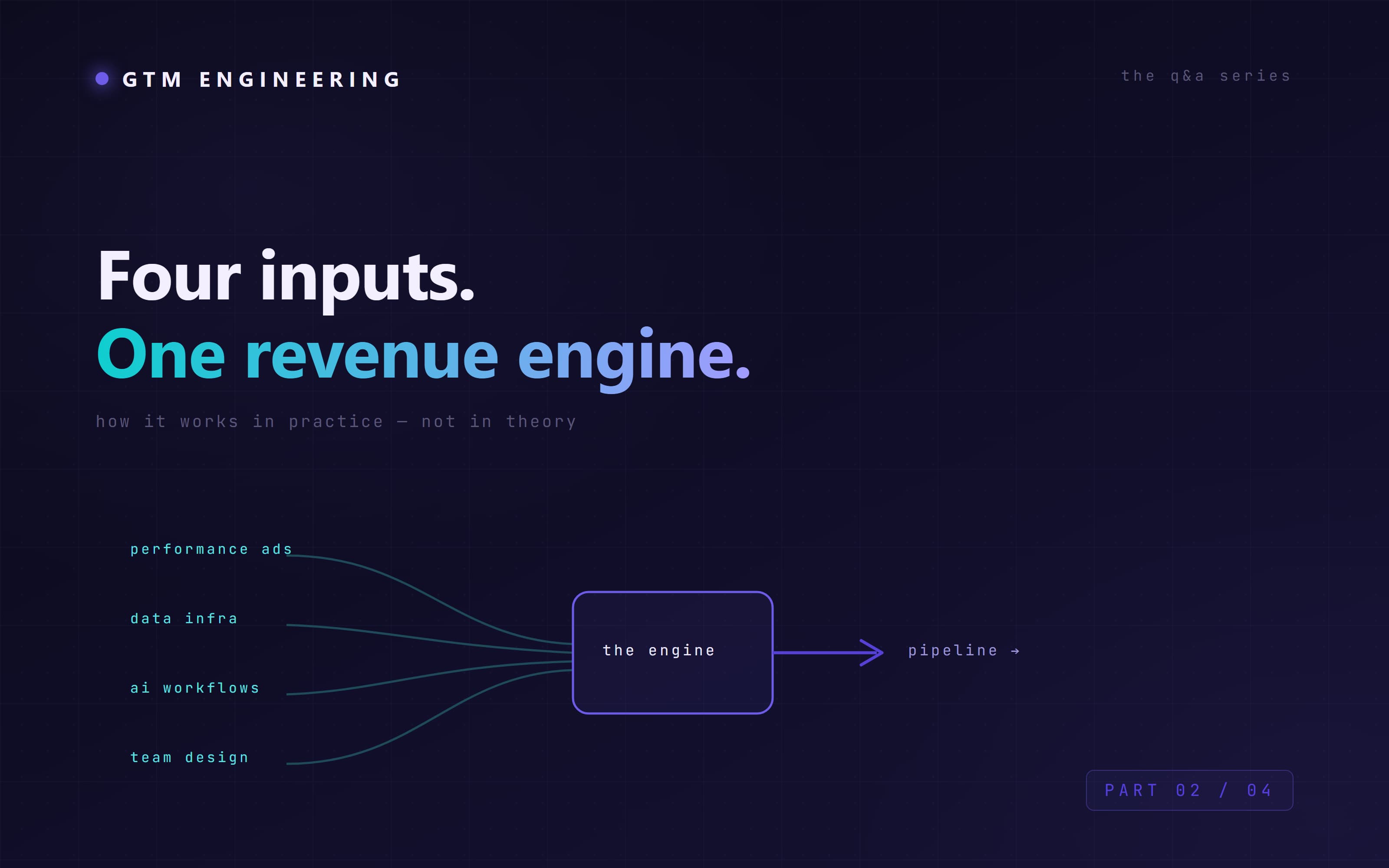
Modern B2B go-to-market is best understood as a three-layer system, where each layer builds on the previous one. Growth problems arise not because teams lack activity, but because they stop at the first layer.
How the three layers stack
- The visible funnel (baseline). Where most GTM teams spend their time: paid ads on Google, LinkedIn, and Meta; cold outbound; inbound content; SEO; events; and marketplace listings. These channels are essential — they create awareness, capture explicit demand, and feed the CRM — but on their own they only reach buyers already close to a decision.
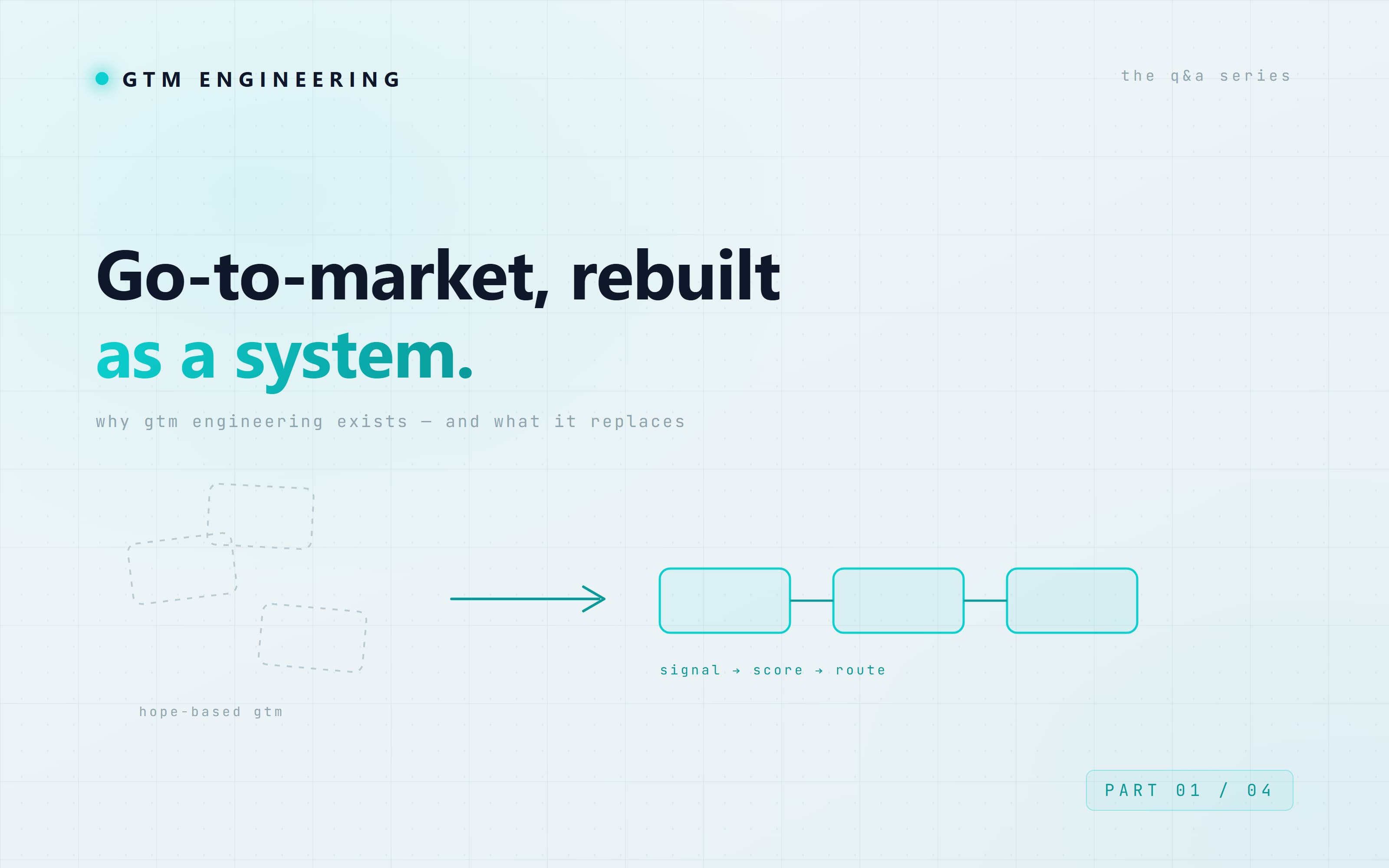
- The signal-led dark funnel. Where most companies fall short. Instead of waiting for buyers to convert, teams monitor signals that indicate movement earlier in the journey. Signals determine which accounts deserve attention, when outreach should happen, and how messaging should be tailored — transforming GTM from reactive execution into proactive engagement.
- Execution and activation. Where signals are turned into action. Enriched data flows into automation workflows that coordinate sales outreach, AI-assisted calling, and hyper-personalized ads. Rather than running in silos, channels work together based on shared intelligence.

“When all three layers operate together, GTM becomes a system — not a set of disconnected campaigns.”
Real-World Signal-Led GTM Examples
These four patterns show how a single detected signal becomes a timely, relevant action — and a better outcome.
Signal to action to result
- Pricing page visitors. Signal: multiple pricing page visits. Action: retargeting plus personalized outreach. Result: higher conversion without waiting for form fills.
- Hiring engineers. Signal: a company hiring for engineers. Action: pitch managed services or tools. Result: timely, relevant conversations.
- Free users using paid features. Signal: a feature usage spike. Action: upgrade campaigns. Result: faster expansion revenue.
- Competitor research. Signal: G2 profile visits. Action: comparison messaging. Result: influence before vendor selection.
What Modern B2B GTM Really Requires
You don't need to track every signal. You need to focus on what actually moves revenue.
- Identify the signals that matter most
- Engineer systems around them
- Continuously optimize the loop

Stop competing for the 2% everyone else is chasing
You don't need to track every signal — you need to identify the ones that matter, engineer systems around them, and continuously optimize the loop. We help B2B teams build that signal-led GTM engine.
Ready to turn signals into booked pipeline?
Book a discovery call and we’ll map out how a signal-led GTM system can accelerate your revenue.