What Is GTM Engineering? (Q&A - Part 1)

Why modern B2B growth needs systems, signals, and engineering - not more tools, more campaigns, or more effort.
Introduction: Why GTM Engineering Is Suddenly Everywhere
If you work in B2B marketing, sales, revenue operations, or growth, you have probably noticed something interesting lately. A term that barely existed a few years ago is now everywhere: GTM Engineering.
Founders talk about it. Growth leaders ask for it. Teams hire for it - often without fully understanding what it means.
This webinar marks the start of a GTM Engineering Q&A series, focused specifically on B2B growth. Instead of hype or buzzwords, the goal is simple: explain why GTM engineering exists, what problem it solves, and how it is different from traditional GTM approaches. This article translates the raw webinar discussion into a clear, structured, and practical explanation - without assuming prior expertise.
Why Go-To-Market Needed Engineering
GTM has always existed - so what changed? Go-to-market is not new. For decades, B2B teams have talked about GTM strategy, GTM plans, GTM campaigns, and product launches.
What is new is the engineering part. Something fundamental changed in how buyers behave and how companies operate.
The Core Problem: Tools Without Systems
Most B2B organizations today have plenty of tools. Yet despite all of them, growth still feels slow, unpredictable, and inefficient. Why? Because tools are not systems.
A typical modern stack already includes:
- Marketing automation tools
- Sales engagement tools
- CRMs
- CDPs
- Analytics platforms
- Product analytics
- Data warehouses
Each team works in isolation: marketing runs campaigns, sales runs outreach, ops manages processes, data teams manage pipelines, and product teams track usage. But these systems do not talk to each other properly. This fragmentation is one of the biggest reasons B2B growth stalls.

Siloed Processes Are Breaking B2B Growth
It is not just tools - processes are siloed too. Marketing follows one playbook, sales follows another, and ops focuses on efficiency. Teams meet monthly to "align."
Most of the time, these meetings turn into:
- Blame
- Frustration
- Guesswork
Hard work increases - but results do not scale. This is why effort no longer equals growth.
Data Is Everywhere, But Insight Is Nowhere
Modern B2B companies are drowning in data: CRM data, web analytics, product usage data, CDPs, data warehouses, and ad platforms.
But the data is broken in three ways
- Fragmented - spread across systems that never reconcile.
- Delayed - insight arrives long after the moment to act has passed.
- Owned by different teams - context lives in silos, not in one place.

As a result:
- Critical buying signals are missed
- Context is lost
- Decisions are made too late
Gartner consistently reports that poor data integration is one of the top barriers to revenue growth in B2B organizations.
Growth Can't Be Guesswork Anymore
For years, B2B growth relied heavily on campaign-based thinking: "Let's try this campaign and see what happens." That approach worked when competition was lower, buyer journeys were simpler, and search dominated discovery. But the market has changed.
Buyer Behavior Has Fundamentally Shifted
Buyers no longer rely on one channel. Google is still important - but it is no longer the only gatekeeper.
Today, buyers:
- Ask questions on social media
- Research on forums
- Watch videos
- Use AI tools
- Explore communities
- Compare tools silently
McKinsey research shows B2B buyers now use 10+ channels during a single buying journey.
What the research signals
channels used in a single B2B buying journey (McKinsey)
barrier to revenue growth: poor data integration (Gartner)
the new signal-first standard for ABM
Why Systems Thinking Matters Now
This shift forces B2B teams to move:
- Campaign thinking to systems thinking
- Guessing to engineering
- Isolated execution to unified orchestration
This is the real reason GTM engineering exists.
“Hard work does not equal growth. Synchronized systems equal growth.”
So, What Exactly Is GTM Engineering?
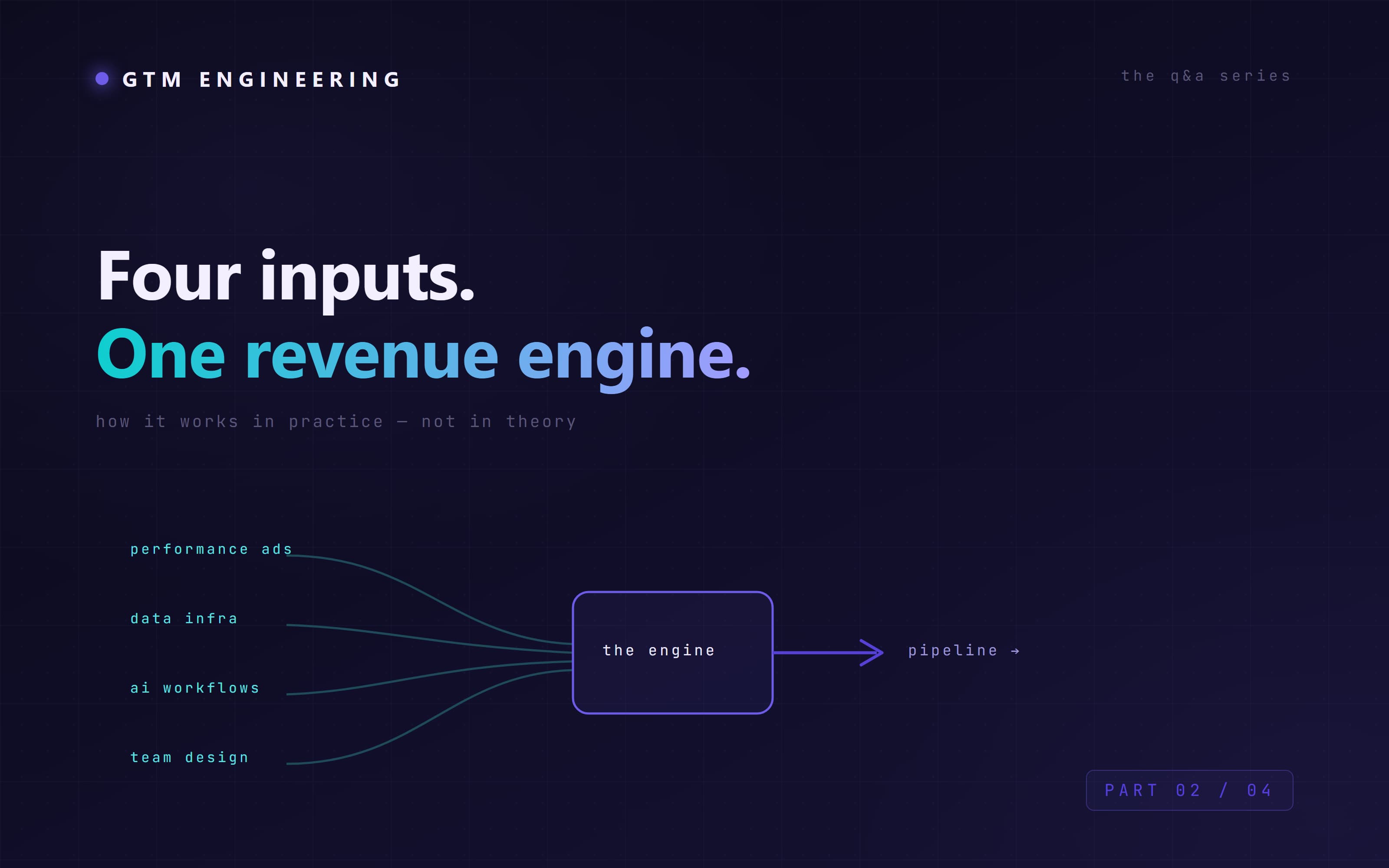
The simple definition: GTM Engineering is the practice of building scalable, automated, signal-driven systems that unify data, ads, automation, and revenue.
It is not a tool, a single role, or a campaign tactic. It is a system design discipline.

Breaking Down the Definition
- Scalable - the system must work across hundreds or thousands of accounts.
- Without adding headcount linearly.
- Automated - manual work does not scale.
- Automation handles data movement, triggered actions, and workflow execution.
- Signal-Driven - actions are triggered by real buyer behavior, not assumptions.
- Unified - everything connects.
- CRM, ads, product data, sales activity, and revenue outcomes all link together.
GTM Engineering Is Not Just Tools
A common misconception: "If someone knows Clay, AI agents, or automation tools - they are a GTM engineer." That is incomplete. Tools are components, not the engine.
- Data architecture
- System integration
- Strategy
- Use-case design

GTM Engineering Is Layered Thinking
GTM engineering works across horizontal layers and vertical use cases. Each layer builds on the previous one.
The GTM Engineering Layers
- Data Architecture
- System Integrations
- Signal Detection
- Automation & AI
- Activation (Ads, Outreach)
- Measurement & Feedback
How GTM Engineering Differs from Marketing Ops
This is one of the most important clarifications. Marketing Ops focuses on execution, campaign setup, project management, and tool configuration. Sales Ops focuses on sales enablement, CRM hygiene, and process efficiency.

What GTM Engineering adds on top
- Integrates marketing ops + sales ops
- Adds data engineering
- Adds automation
- Adds system design
- Turns execution into one unified growth engine
What Problems Does GTM Engineering Solve?
GTM engineering solves two categories of problems.
1. Technical Problems
- Disconnected systems
- Siloed data
- Manual personalization
- Slow funnel velocity
- Wasted ad spend
2. Strategic Problems
- Poor prioritization
- Lack of context
- Inefficient ABM
- Reactive decision-making
Example: Why Context Changes Everything
Imagine this scenario: a lead exists in Salesforce. The same user signs up for a free trial, explores multiple features, and books a demo.
Without integration: sales sees only a demo booking.
With GTM engineering: sales sees full product behavior, marketing adjusts messaging, and ads reinforce relevant value. Context transforms conversion.

GTM Engineering and Funnel Velocity
Disconnected systems slow everything down. Integrated systems speed up qualification, improve personalization, and reduce wasted effort.
This directly impacts:
- Sales velocity
- Conversion rates
- Revenue predictability
How GTM Engineering Powers Modern ABM (ABM 2.2)
Traditional ABM was manual, labor-intensive, and research-heavy. Teams relied on large SDR teams, virtual assistants, and static account lists.
The Shift to Signal-First ABM
GTM engineering enables ABM 2.2, defined as signal-first, intent-driven account targeting. Instead of "Target the top 100 accounts," we move to "Target accounts showing intent right now."
- Website visits
- Pricing page views
- Job postings
- Tech adoption
- Funding events
- Product launches
- Social activity

Why Signals Are the Heart of GTM Engineering
Signals represent buyer intent. Each signal indicates timing - and timing is everything in B2B.
Examples of high-intent signals:
- Visiting pricing pages
- Researching on G2
- Hiring for specific roles
- Adopting new platforms
- Raising funding
HubSpot research shows intent-based engagement significantly increases close rates.
Activation: Turning Signals into Action
Once signals are detected, teams can act in near real time.
- Run targeted ads
- Trigger outreach
- Personalize messaging
- Prioritize accounts
Measurement Completes the Loop
Every signal and action feeds back into the system. Teams learn which signals convert, which channels perform, and which messages resonate. This creates continuous improvement.
Final Thoughts: Why GTM Engineering Matters in 2025
B2B growth is no longer about more campaigns, more tools, or more effort. It is about better systems, faster feedback, and smarter signals.
“GTM engineering is not optional anymore - it is the operating system for modern B2B growth.”
References
Gartner - Revenue Operations & Data Integration. McKinsey - The New B2B Buyer Journey. Forrester - B2B Growth Systems. HubSpot - Intent-Based Marketing Effectiveness.
Ready to turn tools into a growth engine?
If your B2B stack is full of tools but short on synchronized systems, we can help you architect data, signals, and automation into one unified growth engine.


Ready to turn signals into booked pipeline?
Book a discovery call and we’ll map out how a signal-led GTM system can accelerate your revenue.