AI GTM Engine: Using Dark Funnel and Deep Personalization at Scale

Modern B2B buyers research silently and decide before they ever raise their hand. Here is how an AI-powered GTM engine detects that invisible demand and activates it with personalization at scale.
Introduction: Why Traditional GTM No Longer Works
For decades, B2B go-to-market (GTM) strategies followed a familiar and predictable structure. Marketing teams created awareness through campaigns, generated leads, and handed those leads to sales teams. Sales teams then qualified, nurtured, and closed deals. Funnels, stages, and conversions defined success. That model is breaking down.
Modern B2B buyers no longer move through linear journeys. Instead, they research independently, consult peers, read reviews, compare vendors, and delay direct engagement for as long as possible. According to Gartner, B2B buyers now spend only 17% of their total buying time meeting with potential suppliers, and that time is split across multiple vendors.
More importantly, research consistently shows that 95-98% of B2B buyers are not actively in-market at any given moment, meaning they never appear in traditional lead funnels. This invisible majority represents the largest missed growth opportunity in modern B2B GTM.
The modern buyer, by the numbers
of buying time spent meeting suppliers (Gartner)
of B2B buyers are not in-market at any moment
decision-makers involved in a B2B purchase (McKinsey)
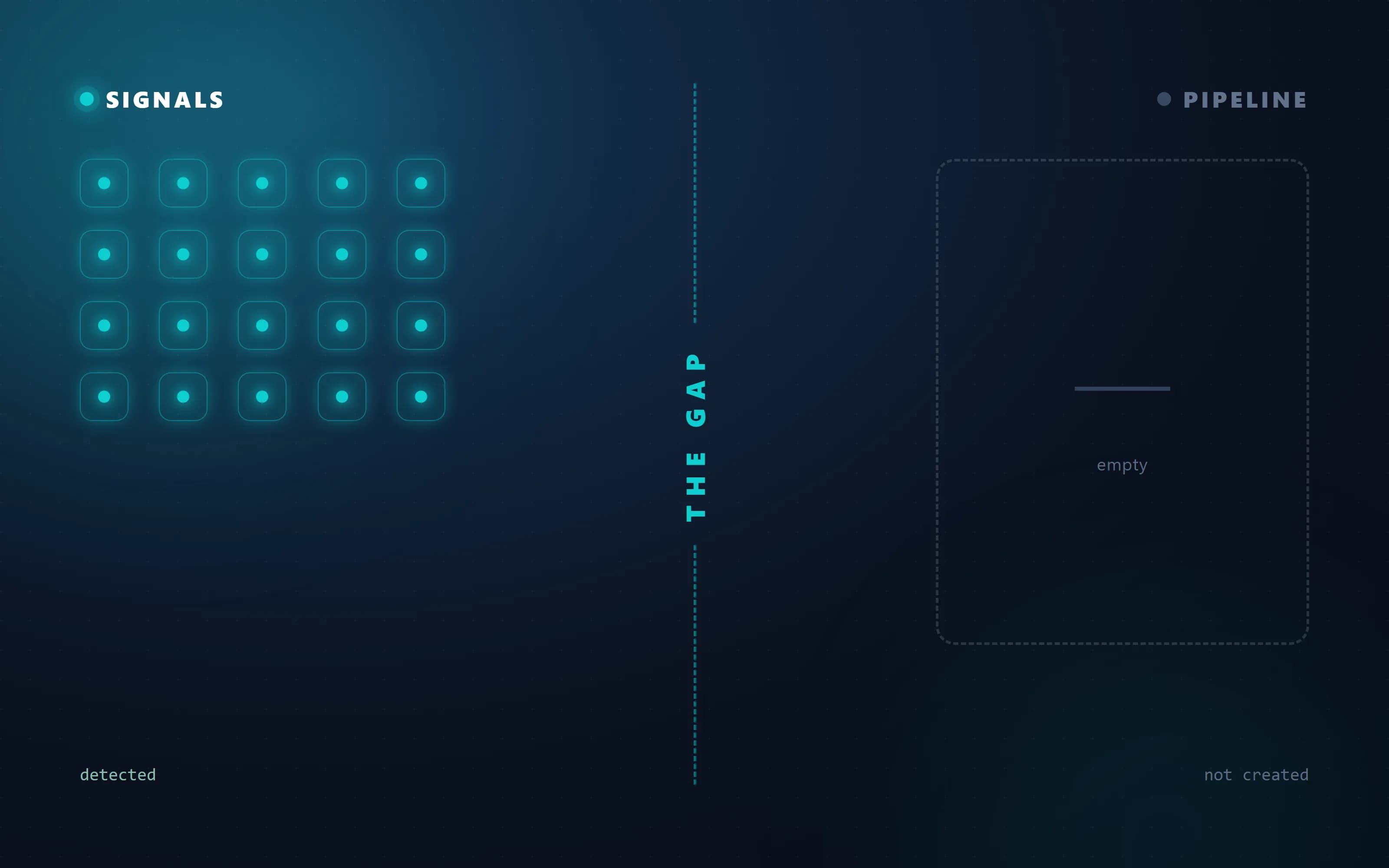
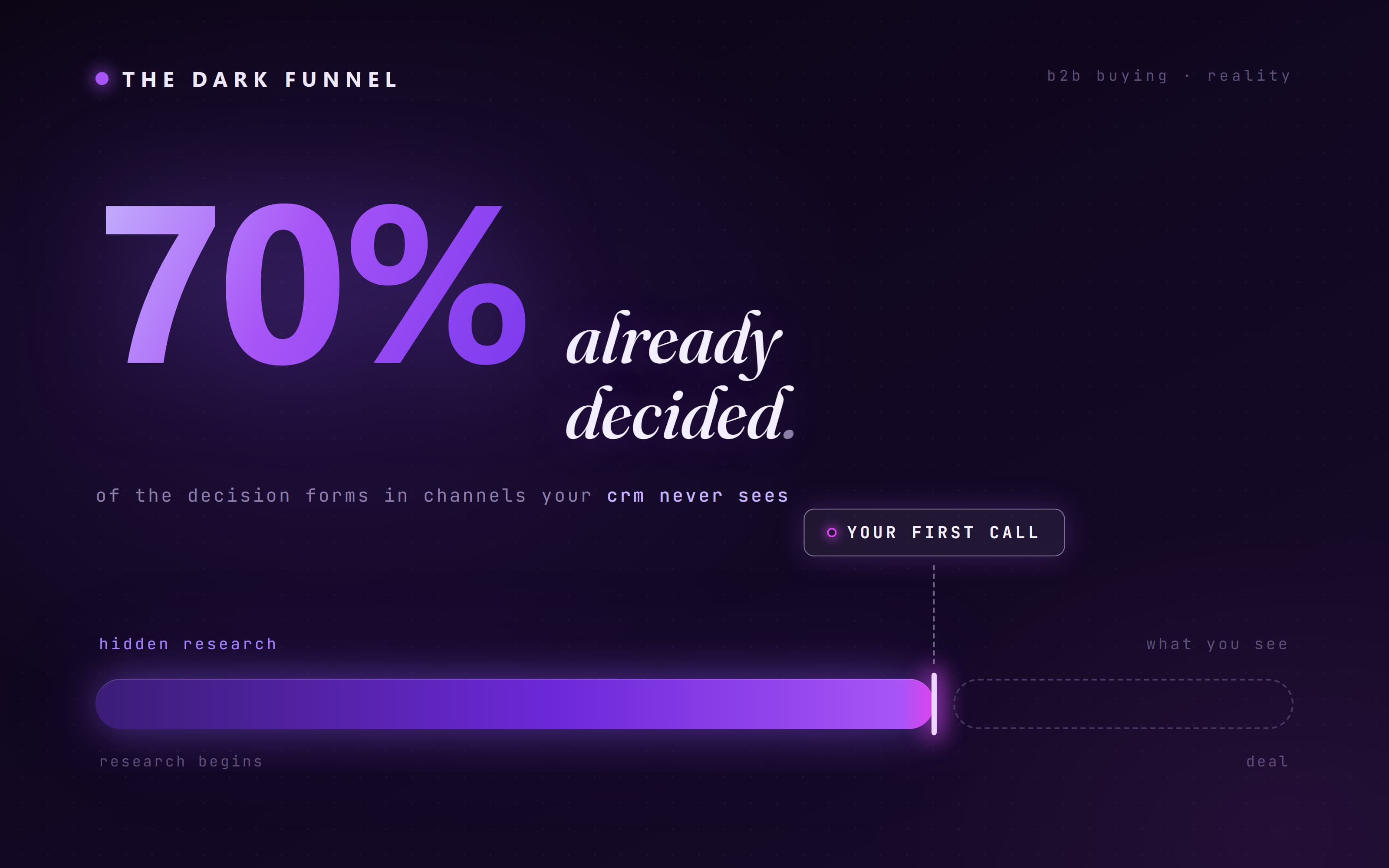
These buyers are not inactive; they are simply unseen. They don't fill out forms, book demos, or respond to outbound campaigns. Yet they are actively researching, evaluating options, and preparing to buy. This hidden activity takes place in what is known as the dark funnel.
An AI-powered GTM engine is no longer a competitive advantage; it is a requirement for detecting, understanding, and activating this invisible demand at scale.

Understanding the Dark Funnel
The dark funnel refers to all buyer activity that occurs outside traditional, trackable marketing and sales touchpoints. It includes research, internal discussions, vendor comparisons, and early intent signals that never reach your CRM. Traditional GTM models assume buyers move through clean, sequential stages:
The four assumed buying stages (and what really happens)
- Awareness - buyers realize a problem or opportunity exists. They consume blogs, reports, and industry discussions, often without engaging directly.
- Example: A CTO reads multiple articles about cloud cost overruns but doesn't interact with any vendor. This research stays invisible to traditional funnels.
- Interest - buyers actively explore solutions. They compare tools, read reviews, and visit competitor websites, usually without filling out forms.
- Example: A RevOps leader compares CRM automation tools, visits pricing pages, and reads G2 reviews but never books a demo.
- Desire - buyers start leaning toward a specific solution. They evaluate ROI, pricing, and internal alignment. Preferences are often formed before any sales conversation begins.
- Example: An operations team internally agrees on a shortlist of two vendors before contacting either company.
- Action - the visible step: demo requests, form submissions, or purchases. While easy to measure, it represents only a small portion of the buying journey.
- Example: By the time a demo is booked, the buyer may already have a preferred vendor in mind.
In reality, the modern buyer journey is fragmented and non-linear. Buyers jump between channels, revisit stages, pause for weeks or months, and involve multiple stakeholders. McKinsey research shows that B2B buying decisions now involve 6-10 decision-makers, each independently gathering information.
The issue is not that buyers disappeared. The issue is that visibility disappeared.
Buyers are still active everywhere; your systems just cannot see them. They are:
- Visiting websites anonymously
- Reading documentation and pricing pages
- Researching competitors
- Posting job openings that signal growth
- Using free or trial versions of products
- Engaging silently with ads and content
But most GTM systems are blind to this activity. As a result, companies focus all their efforts on the small fraction of buyers who raise their hand, while ignoring the majority who are preparing to buy quietly.
“The issue is not that buyers disappeared. The issue is that visibility disappeared.”
The Cost of Ignoring the Dark Funnel
Ignoring the dark funnel creates structural inefficiencies in GTM execution.
Four structural costs of dark-funnel blindness
- Hyper-competition. When everyone targets the same bottom-of-funnel keywords, audiences, and accounts, acquisition costs rise sharply. According to Forrester, rising competition in paid channels has significantly increased customer acquisition costs across B2B industries.
- Late engagement. By the time a buyer fills out a form, they may already have shortlisted vendors or made a preliminary decision. LinkedIn's B2B Institute found that most buyers form preferences before engaging with sales.
- Sales and marketing misalignment. Marketing optimizes for lead volume, while sales struggles with poorly timed or low-intent opportunities.
- Capped growth. A GTM strategy that only captures visible demand is inherently limited. The dark funnel is not an edge case - it is where most B2B buying behavior actually occurs.
From Reactive to Proactive Prospecting
Traditional GTM is reactive by design. Teams wait for form fills, demo requests, and inbound emails. Modern GTM must be proactive.
Proactive prospecting is not about increasing cold outreach volume. It is about identifying intent earlier and engaging with relevance.
High-performing GTM teams now ask different questions:
- Who is researching solutions like ours right now?
- Which accounts are showing early intent signals?
- Who is likely to enter a buying cycle in the next 30-90 days?
This shift requires abandoning campaign-led thinking and adopting signal-led, persona-focused GTM. Buyers do not respond to campaigns. They respond to relevance.
Why AI Is Essential for the Dark Funnel
The dark funnel has always existed. What has changed is the ability to detect and interpret it. Advances in AI, machine learning, and data infrastructure now make it possible to operate at a scale that manual GTM never could.
- Detect buying signals across multiple channels
- Connect fragmented data sources into unified profiles
- Personalize messaging at scale
- Continuously optimize GTM execution

The DARK Framework: A Modern GTM Operating System
To operationalize the dark funnel, we use a continuous loop called DARK: Detect, Augment, Reach, Kaizen. This framework functions as a GTM operating system rather than a one-time workflow.

Detect: Identifying Intent Signals
Detection is the foundation of the AI GTM engine. Buyers emit intent signals across digital touchpoints long before they engage with sales. According to Gartner, intent data can surface buying behavior weeks or months before direct engagement.

Common dark funnel signals
- Anonymous website activity. Visits to pricing pages, product documentation, or comparison pages indicate active evaluation.
- Job postings and hiring trends. Hiring for technical or operational roles often signals expansion, transformation, or new initiatives.
- Product usage data. Free users interacting with premium features, or increased usage frequency, often signal readiness to upgrade.
- Competitor research. Search behavior, review-site activity, and comparison-content consumption indicate vendor evaluation.
- Funding, M&A, and expansion events. New capital almost always triggers new technology and service purchases.
- Engagement without conversion. Ad impressions, content consumption, email opens, and profile views are all meaningful intent signals.
Detection is not about collecting everything - it is about identifying signals that correlate with revenue outcomes.
Augment: Enriching Signals Into Buyer Intelligence
Raw signals lack context. Augmentation transforms data into intelligence.
This stage enriches signals with
- Firmographic data
- Technographic data
- Persona and role mapping
- Behavioral history
- Account-level intent scoring

AI enables identity resolution across systems, connecting anonymous behavior to real accounts and prioritizing opportunities based on likelihood to buy. Instead of static lead lists, teams gain dynamic buyer profiles that evolve in real time.
Reach: Activating Buyers With Personalization at Scale
Once intent is detected and enriched, activation begins. The goal is not outreach volume - it is precision.
Activation channels span the buyer's environment:
- Personalized email outreach
- LinkedIn and social messaging
- Paid retargeting (LinkedIn, Google, Meta)
- Website and landing page personalization
- AI-powered voice and chat agents
AI-driven personalization adapts messaging based on:
- Signal type
- Buyer stage
- Persona
- Industry context
McKinsey research shows that personalized B2B engagement can increase revenue by up to 15% when executed effectively.
“Buyers do not respond to campaigns. They respond to relevance.”
Kaizen: Continuous Learning and Optimization
Kaizen represents continuous improvement. Every interaction feeds back into the GTM engine.
The engine constantly asks:
- Which signals convert?
- Which messages resonate?
- Which channels perform best?
AI models then learn and refine:
- Signal scoring
- Messaging strategies
- Timing and sequencing
Over time, the GTM system becomes more accurate, efficient, and predictive. This is how GTM performance compounds.
Building the AI GTM Engine
An AI GTM engine is not a single tool - it is an integrated system with three core components.
The three engines of an integrated GTM motion
- Signal Engine. Ingests data from multiple sources, scores intent, and prioritizes accounts dynamically.
- Personalization Engine. Enriches profiles, maps personas, and generates context-aware messaging.
- Activation Engine. Orchestrates execution across CRM, ad platforms, sales tools, and analytics. Together, these components create a unified GTM motion.

Real-World Use Cases
These use cases demonstrate how dark funnel signals translate directly into pipeline.
- Funding-based outreach triggered by investment announcements
- AI-powered inbound follow-up using voice agents
- Account-based advertising aligned with CRM intent data
- Hiring-spike detection for services and recruitment firms

The Importance of Unified GTM Operations
Dark funnel execution cannot live in silos. It requires shared data, aligned incentives, and unified ownership across marketing, sales, and operations. Forrester emphasizes that revenue-growth leaders align GTM teams around shared buyer intelligence.
Common Pitfalls to Avoid
Technology amplifies strategy; it cannot replace it. Watch for these traps:
- Tracking too many signals without prioritization
- Treating AI as a tool instead of a system
- Over-automating without relevance
- Failing to align sales and marketing
The Future of B2B GTM
B2B GTM is shifting on three fundamental axes:
- Lead-based to signal-based
- Campaign-led to buyer-led
- Reactive to predictive
Organizations that master AI-powered dark funnel strategies will engage buyers earlier, reduce acquisition costs, and win deals before competitors enter the conversation.
Build your AI GTM engine before competitors enter the conversation
The companies that win will not market louder; they will listen better and act at exactly the right moment. We help B2B teams detect dark-funnel intent and activate it with personalization at scale.
Ready to turn signals into booked pipeline?
Book a discovery call and we’ll map out how a signal-led GTM system can accelerate your revenue.