Why Your Buyers Have Already Decided Before You Call

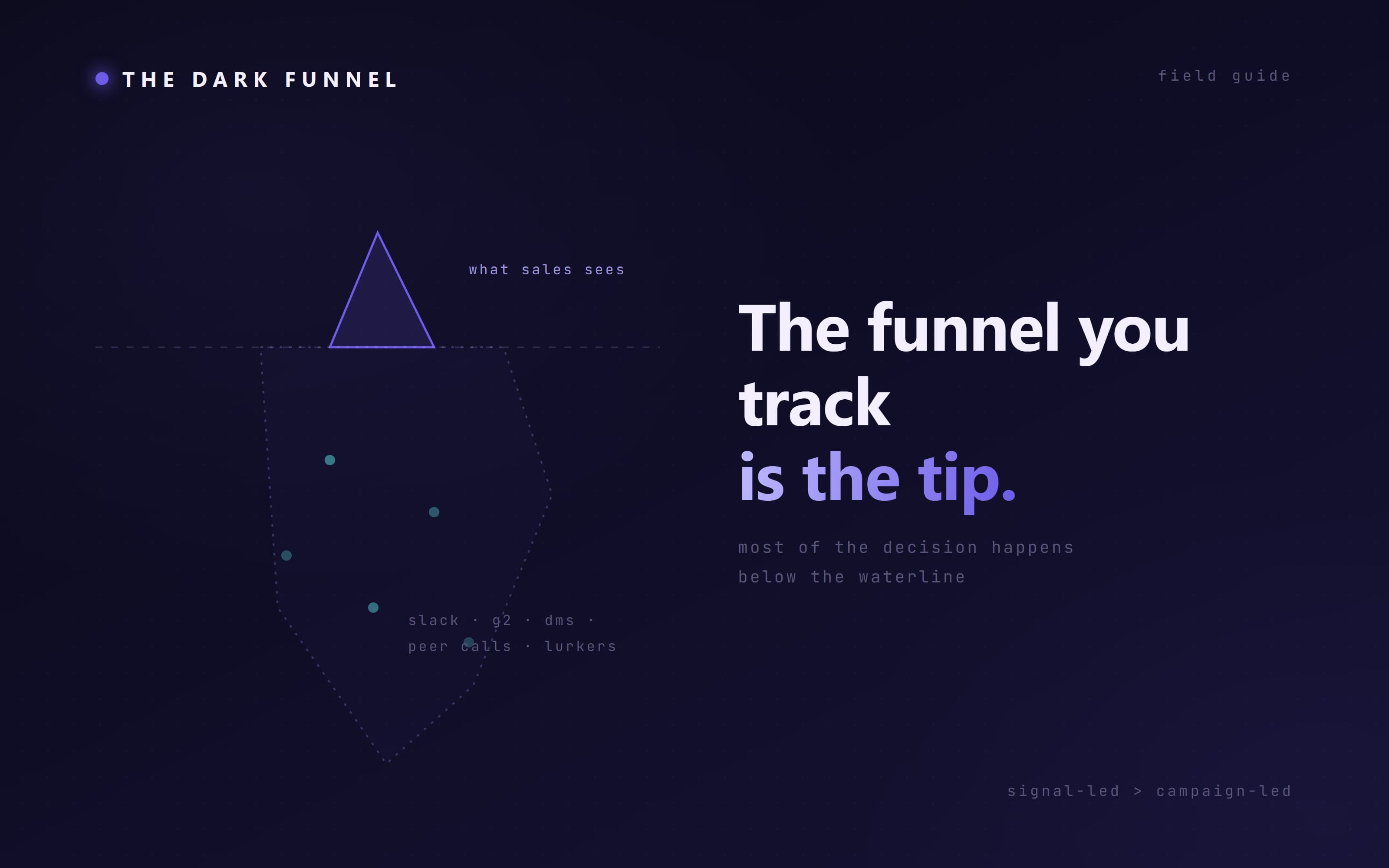
By the time a buyer fills out your form, books a demo, or replies to an outbound email, most of the decision has already happened. The real buying process lives in the Dark Funnel, and that is where your next ten deals are already forming.
By the time a buyer fills out your form, books a demo, or replies to an outbound email, a lot has already happened.
Roughly 70% of the buyer's decision is already made before they ever talk to you. You are not losing deals in the sales cycle. You are losing them before it starts.
Yet most B2B go-to-market engines are still built to respond to the final 20%. They are still obsessed with:
- Form fills
- Demo requests
- Cold replies
That is not your funnel, it is only the receipt. What about the real buying process? Well, that is happening somewhere else.
That is the Dark Funnel. And it is where your next 10 deals are already forming. Most of it is already dead before your first rep dials, not because your product is weak, and not because your team is not working hard enough, but because your GTM engine is designed to see only the final 20% of the buyer journey.
The other 80%? It is happening right now in Slack communities, private LinkedIn threads, G2 review pages, and peer conversations your CRM will never capture. That is the Dark Funnel.
The buyers who are going to buy from you are already researching you. Does your team know that?

The Core Problem: Your GTM Engine Is Flying Blind
A lot of B2B systems still assume the same thing: if a prospect is serious, they will let you know. They will fill out a form, reply to a sequence, or click the ad and request the demo.
That assumption used to be more or less fine. It is not fine anymore. Today's buyers are better informed, more cautious, and far more self-directed. They do a huge amount of research before they ever speak to sales, and they do that research in places your team usually does not own, cannot fully see, and often does not monitor well.
That matters more than many teams realize. It means your SDRs are often reaching out to people who already know your category, already know your competitors, already have objections, and already have internal opinions forming around your pricing, positioning, and product gaps.
It means marketing may be optimizing a funnel that begins too far downstream. It means sales is stepping into conversations that feel like first-touch conversations on your side, but are actually mid-journey conversations on the buyer's side.
That gap creates a hidden tax on your whole go-to-market motion:
- You spend more to create urgency that was already there.
- You send more outbound because you are late.
- You push harder on visible channels because the invisible part feels harder to operationalize.
And over time, that compounds. You are not just missing some leads. You are missing timing. And in B2B, timing changes everything.
“You are not losing deals in the sales cycle. You are losing them before it starts.”
What Changed, Really?
This shift did not happen overnight. But it is very real now. Three forces came together to move early buying intent out of your line of sight.
The three shifts behind the Dark Funnel
- Buyers learned how to stay invisible. Senior decision-makers stopped raising their hands. Cold email got noisier. InMail got crowded. Forms stopped being where early intent lives. Today's buyers do their research quietly, and they are very good at it.
- Data got better. Five years ago, building a signal-led motion required an enterprise budget. Not anymore. Tools like Clay, Bombora, and Common Room have made signal capture, enrichment, and scoring accessible to any mid-market team.
- AI made interpretation cheap. This is the one that changes everything. It is no longer expensive or slow to turn raw behavioral signals into actionable intelligence. Any team can now do what only well-funded RevOps teams could do three years ago.

Old GTM Thinking vs. Signal-Led GTM
Put those three shifts together, and here is what the before-and-after actually looks like in practice.
From old GTM thinking to a signal-led motion
- Primary signal: MQL gives way to intent signals as the primary signal.
- Outreach: Volume-based outreach gives way to precision-based, context-aware outreach.
- Funnel view: A visible-funnel-only view gives way to the Dark Funnel and the visible funnel together.
- Trigger: Sequences triggered by a form fill give way to sequences triggered by a behavioral pattern.
- Prioritization: Rep intuition gives way to signal scoring that drives prioritization.
Signal-Led GTM is not a plugin. It is not a new tool you bolt onto what you are already doing, hoping for better results. It is a completely different way of running go-to-market.
How Most Teams Get This Wrong
Signal-Led GTM is one of the most talked-about frameworks in B2B GTM circles right now. Which means a lot of teams are attempting it, and many are doing it badly. Here are the five failure patterns we see most consistently.
Mistake 01: Treating intent data as a list, not a system
- Here is what happens: the team buys Bombora, pulls a hot list, then hands it to SDRs. SDRs dial. Nothing converts. Leadership says intent data does not work. It does work, just not as a list.
- Intent data without enrichment, without context, and without a playbook attached is just a more expensive cold list. Signals have to be operationalized. You cannot just import them and hope.
Mistake 02: Chasing single signals instead of clusters
- One signal is noise. A cluster is a buying pattern.
- A founder who downloaded your whitepaper is mildly interesting. But that same founder who is also showing a cluster of motion is someone you call today:
- Just posted a job for the RevOps role your product replaces
- Started following your CEO on LinkedIn three weeks ago
- Attended a competitor webinar last Thursday
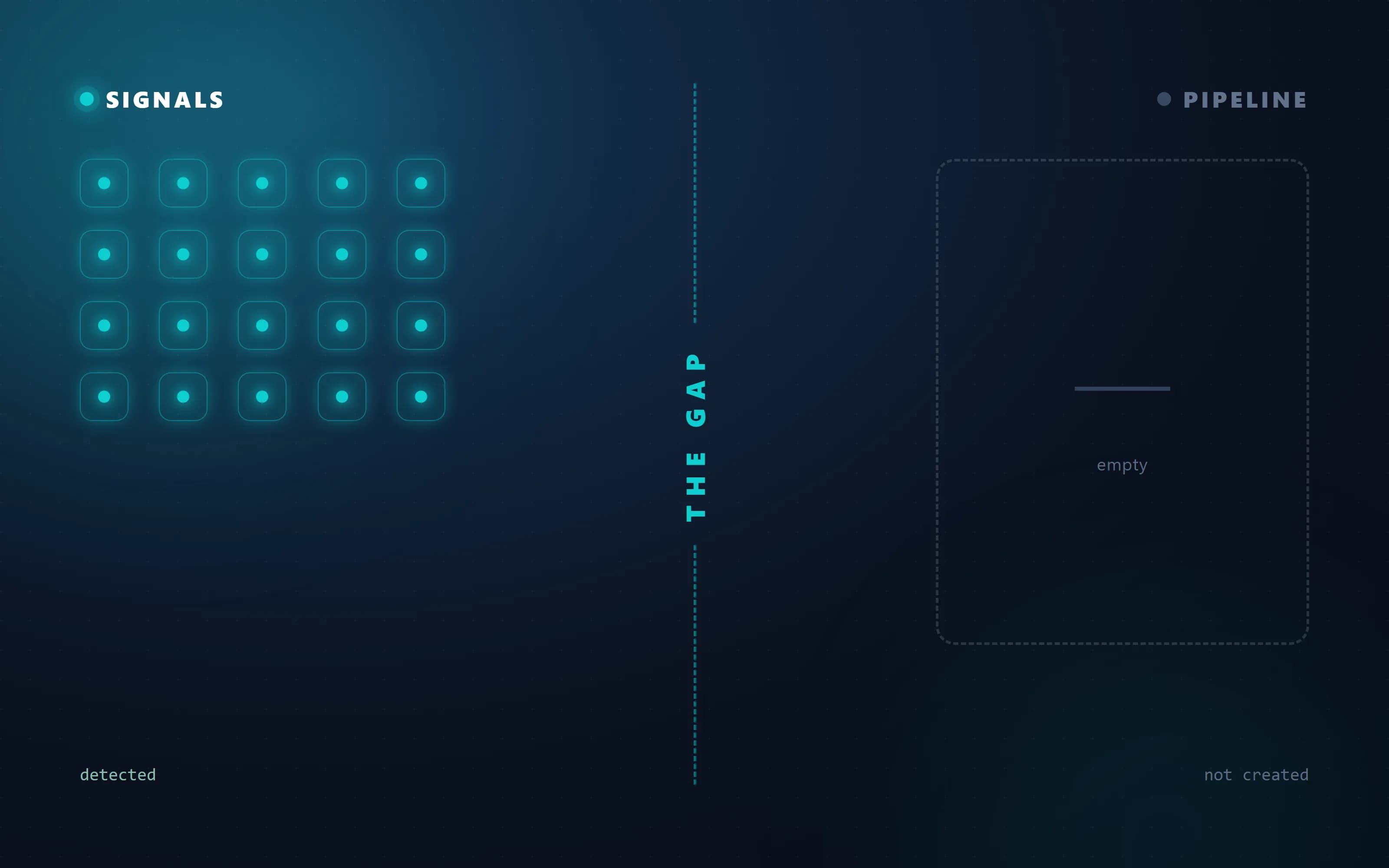
- Most teams have the data to see individual signals. Very few have the infrastructure to connect them. That is the gap.
Mistake 03: Waiting until the model is perfect
- Some teams spend five months debating signal weightings, mapping ICP tiers, and building CRM workflows, and never send a single outreach message based on a signal. Stop that.
- Pick 3 to 5 signals you are confident in. Run a play. See what converts. Refine. That feedback loop is how the model gets good. Waiting to be perfect before starting means never starting.

Mistake 04: Ignoring the Dark Funnel because it is hard to attribute
- Finance wants clean numbers. So teams default to paid search, gated content, and email, things that show up neatly in dashboards. Dark Funnel activity does not attribute cleanly, so it gets deprioritized.
- Here is the irony: the accounts most influenced by your Dark Funnel, your community presence, thought leadership, and peer reviews, are often your fastest-closing, highest-ACV deals. If you only fund what you can measure today, you are systematically starving your best channel.
“If you only invest in what you can measure today, you systematically starve your best channel.”
Mistake 05: Making signal research the rep's job
- Telling AEs to research signals before every call sounds reasonable in a planning meeting. It does not happen. Not consistently. Not at the depth that changes how a rep shows up.
- Signal context needs to live in the CRM, pre-built, before the rep opens the account. The moment you make it a manual task, you have made it optional. And optional means inconsistent. Reps should receive context, not generate it.
A Practical Way to Think About a Signal-Led GTM System
Let us get practical. What does a Signal-Led GTM engine actually look like when it is built and running? Not in theory. Not as a slide deck. As a system with five distinct layers, each with a specific job, and a clear handoff to the next.
Think of this as the architectural model for how signals flow from source to sales action. Every layer matters. Miss one, and the whole thing breaks down.

The five layers of a signal-led engine
- Signal Capture. Track intent across channels: job posts, content engagement, community activity, and tech stack changes. Sources include LinkedIn, G2, Bombora, Clay, and Common Room.
- Signal Enrichment. Layer firmographic and technographic context onto raw signals to score account readiness. Tools include Clay, Clearbit, Apollo, and HubSpot.
- Account Prioritization. Score and tier accounts based on signal strength, ICP fit, and buying stage, using a custom scoring model in your CRM or in Clay.
- Playbook Activation. Trigger the right outreach motion per signal type, whether cold, warm, or expansion, using tools like Smartlead, Reply.io, Outreach, or Salesloft.
- Signal Feedback Loop. Measure which signals convert, refine scoring, and improve the ICP definition over time using CRM reports and revenue attribution tools.
Where the Dark Funnel Fits Into All of This
The Dark Funnel sits mostly in that first layer, Signal Capture, but it deserves separate attention because it behaves differently from standard demand gen data.
This is what InsightsTap is built to solve. We map the signals hiding in your Dark Funnel, job changes, funding rounds, intent spikes, and community activity, and turn them into a pipeline your competitors cannot see. You do not need more leads. You need to see the ones already moving.
A More Realistic Example
Say you are running GTM for a B2B SaaS company and your team keeps asking the same question every quarter: "Why are we getting meetings but losing the right deals?"
The first instinct is always timing. You are showing up after the decision is already forming. The accounts that close best rarely fill out a form first. They show motion weeks earlier: a hiring change, repeat content engagement, a spike in review activity.
The team stops sending more. They start sending smarter. Response quality improves. Meetings feel warmer. Reps walk in with context instead of generic openers. The pipeline gets smaller in volume but far stronger in intent. That is the shift.
“You don't need 50 signals. You need 3 strong ones and a clear play for each.”
What This Means for Founders and Revenue Leaders
Signal-led GTM is not a tooling change. It is an operating shift.
Most teams still measure GTM health by activity: calls made, emails sent, SDR output. But activity does not equal targeting. A busy team can still be aiming at the wrong accounts. Most teams also treat form fills as the start of demand. In reality, they are usually the visible end of demand. And many companies build their ICP only from closed-won deals, when the real lessons often sit inside lost deals, stalled opportunities, and churn.
- Before buying more tools, define your five highest-confidence signals. Write them down.
- Map them to buying stages and decide what action each signal should trigger.
- Make the signal context visible inside the CRM. Reps should not have to assemble the story across multiple tools.
- Assign ownership. Signals need someone responsible for sourcing, enrichment, prioritization, and feedback loops.

Without ownership, signal data becomes interesting insight that never changes execution.
A Quick Word of Caution
There is real upside here, but there are also a few ways teams get this wrong.
- Over-automation. Signals should improve judgment, but they do not replace it. Good reps still need to think, good marketers still need to interpret, and good operators still need to refine.
- Stale data. Not all signals age the same way. A fresh engagement signal is not the same as a six-week-old job post. Time matters more than many teams account for.
- Trust. You do not want personalization to feel invasive. Buyers can tell the difference between "this team understands our context" and "this team seems to be tracking us too closely." A good signal-led GTM should feel smart, not unsettling.
- Tool sprawl. More platforms do not automatically create more clarity. Often the opposite happens. Start with a minimum viable stack, make it work, then expand carefully.
The Takeaway
Most B2B teams do not have a demand problem. They have a visibility problem.
Here is what that means in practice:
- Buyers are already researching, comparing, and forming opinions before they ever fill out a form.
- Budgets move and shortlists form quietly, long before GTM systems usually detect them.
- Traditional GTM setups often notice demand too late in the buying journey.
- The Dark Funnel simply reflects how modern buying actually happens. Buyers rarely move from zero to demo request in a straight line, they read, compare, ask peers, revisit options, and discuss internally.
The teams that win are not always the ones with the loudest outbound motion. They are the ones that detect movement earlier, understand the context, and show up at the right moment with relevance.
That is what signal-led growth is about. Not more noise. Not more tools for the sake of it. Just a smarter way to recognize when buying has already begun.
Ready to build your signal-led GTM engine?
At InsightsTap, we help B2B teams build GTM systems around real buying signals, not just form fills. If your outbound is getting louder but results are not improving, the problem may not be effort, it may be the GTM architecture. We will map your current signal coverage, identify Dark Funnel gaps, and help you design a signal-led playbook you can operationalize within 30 days.

Ready to turn signals into booked pipeline?
Book a discovery call and we’ll map out how a signal-led GTM system can accelerate your revenue.