What Is ABM 2.0 — And How to Turn Anonymous Signals Into Revenue Wins

Buyers stopped raising their hands. ABM 2.0 is the signal-driven, AI-powered evolution of account-based marketing that detects buyer intent early — especially while it is still anonymous.
Introduction: Why ABM Had to Evolve
Account-Based Marketing (ABM) has long been considered the gold standard for B2B growth. For years, revenue teams relied on carefully curated target account lists, personalized outreach, and tight sales–marketing alignment to land high-value enterprise deals.
But something changed. Buyers stopped raising their hands.
Today's B2B buyers research quietly. They compare vendors anonymously, read reviews, browse pricing pages, ask questions in private communities, and involve multiple stakeholders long before ever filling out a "Contact Us" form. By the time sales teams engage, the deal is often already halfway decided.
This shift gave rise to ABM 2.0 — a signal-driven, AI-powered evolution of traditional ABM that focuses on detecting buyer intent early, especially when it is still anonymous.
In this blog, we will break down:
- What traditional ABM (ABM 1.0) got right — and where it falls short
- What ABM 2.0 really means in practice
- Why anonymous signals are the hidden goldmine of modern B2B marketing
- A step-by-step ABM 2.0 playbook with real-world examples
- How to build an early-warning system for revenue growth

Section 1: The Evolution of Account-Based Marketing
To understand ABM 2.0, we need to understand where ABM started.
What ABM looked like 5–10 years ago (ABM 1.0) was list-based, campaign-driven, human-heavy, and late-stage focused.
A Typical ABM 1.0 Workflow
- Build a target account list
- Identify decision makers
- Run manual data enrichment
- Send email / LinkedIn outreach
- Wait for a response
Sales and marketing teams typically:
- Bought expensive contact data
- Ran static email sequences
- Waited for replies or form fills
- Focused only on a small number of high-value accounts
This worked — but only at scale, and only for companies with large budgets.
The Problem: Buyers Changed Faster Than ABM Did
Modern buyers behave nothing like the prospects ABM 1.0 was designed for.
- Prefer self-education
- Avoid sales conversations early
- Involve 6–10 stakeholders per deal
- Research anonymously for weeks or months
According to Gartner, over 75% of the B2B buying journey happens before a buyer talks to sales (Gartner, 2022). Traditional ABM simply was not built for this reality.
The new buying reality, by the numbers
of the B2B buying journey happens before a buyer talks to sales (Gartner, 2022)
of website visitors ever fill out a form (HubSpot, 2023)
stakeholders involved in a typical modern B2B deal
Section 2: The Dark Funnel Reality
The dark funnel refers to all the buyer activity that happens outside of your visible CRM data.
- Anonymous website visits
- Pricing page views without form fills
- G2 or Capterra comparisons
- Social media or community discussions
- Hiring signals
- Technology adoption signals
- Funding or M&A activity

“None of this shows up as a "lead." Yet it is where buying decisions actually begin.”
Why Traditional ABM Missed the Dark Funnel
In ABM 1.0, marketing waited for inbound form fills, sales waited for "interested" replies, and intent was inferred far too late.
By the time a prospect filled out a form, they had already:
- Shortlisted vendors
- Compared pricing
- Read reviews
- Talked to competitors
This put revenue teams at a massive disadvantage.
Section 3: Why Traditional ABM Falls Short
Let's break down the core limitations.
1. Reactive, Not Proactive
- Traditional ABM reacts to form fills, email replies, and demo requests.
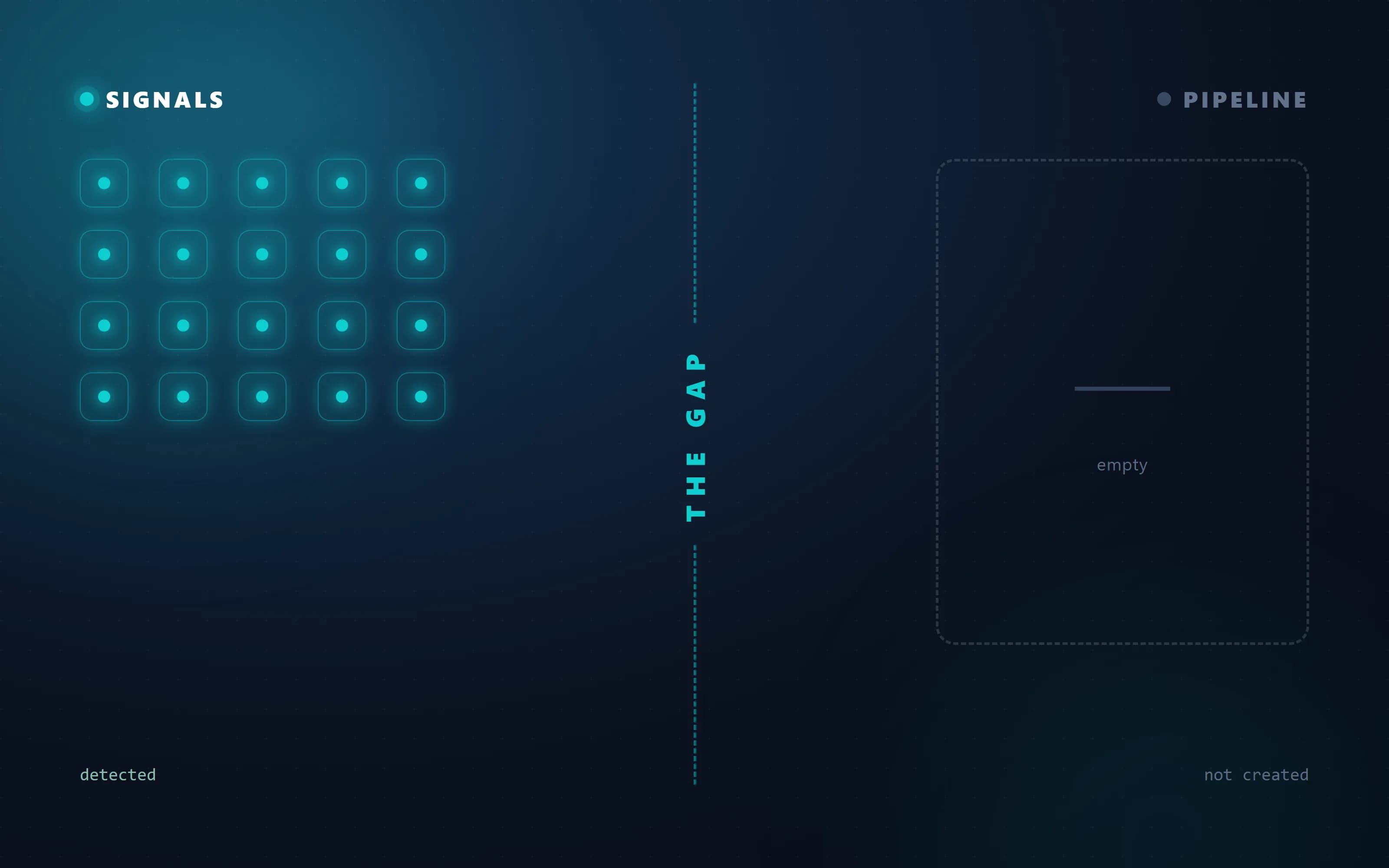
- But only ~2% of website visitors ever fill out a form (HubSpot, 2023).
- That means 98% of intent goes ignored.
2. Siloed Sales and Marketing
- Marketing generated leads; sales followed up.
- Feedback loops were slow or nonexistent.
- This caused:
- Missed timing
- Poor personalization
- Low conversion rates
3. Static Campaigns
- Took weeks to launch
- Could not adapt in real time
- Ignored live buyer behavior
Buyers, however, move dynamically — and the old campaign model could never keep pace.

Section 4: The Shift to ABM 2.0 (Signal-Driven Growth)
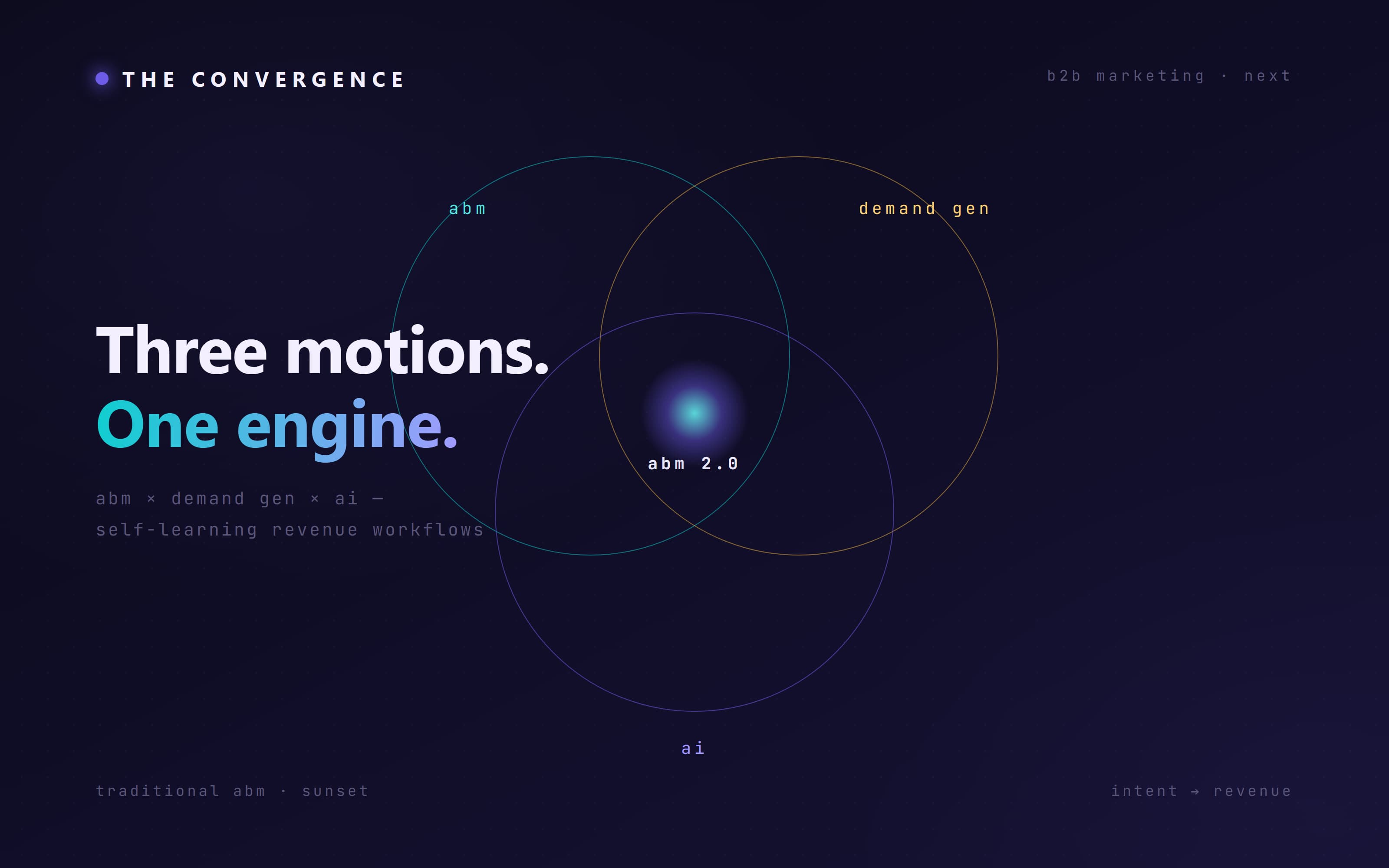
ABM 2.0 is not just a tactic change — it is a mindset shift built around three major shifts.
1. From List-Based to Signal-Driven
- Instead of starting with a static list, ABM 2.0 starts with signals:
- Hiring a new CIO
- Recent funding
- Multiple website visits
- G2 comparison activity
- New technology adoption
- The flow becomes: Signals → Accounts → People → Personalized Engagement.
2. From Reactive to Proactive
- ABM 2.0 detects intent before prospects reach out.
- Think of it as a revenue early-warning system, similar to radar in aviation or defense.
- The earlier you detect intent, the more influence you have.
3. Recognition of Invisible Buyer Intent
- With AI, automation, and intent platforms, teams can monitor markets continuously.
- Detect intent patterns.
- Act without manual research.
Section 5: Key Traits of ABM 2.0
How do you know you are truly doing ABM 2.0?

- Signal-driven engagement — capture signals, identify accounts, and personalize outreach based on context.
- Real-time orchestration — alerts in Slack or CRM, instant outreach triggers, and dynamic campaign changes happen automatically.
- Revenue (RevOps) alignment — marketing, sales, and customer success operate as one revenue team.
- Contextual personalization — outreach references what is actually happening inside the account.
- Full lifecycle coverage — from acquisition to expansion to retention to upsell.
Section 6: Anonymous Signals — The Hidden Goldmine
Not all signals are equal. Start with low-hanging fruit — the high-impact anonymous signals already hiding in your data.
High-Impact Anonymous Signals
- Website visits without form fills.
- Who visited?
- Which pages?
- How often?
- Pricing + case study views = strong buying intent.
- Multiple employees from the same company — this indicates internal buying conversations.
- Ad clicks without conversion — perfect for retargeting and outbound follow-up.
- Review site activity — G2, Capterra, and SourceForge comparisons signal active evaluation.
- Community and social mentions — buyers often ask peers before vendors.
Section 7: Why Anonymous Signals Matter
The Three Advantages
- Earlier funnel entry. Instead of engaging at the bottom of the funnel, ABM 2.0 engages at the top or middle.
- Better context. Signals tell you:
- What the buyer cares about
- Where they are in the journey
- Competitive advantage. If you engage before competitors, you shape the narrative.
“The earlier you detect intent, the more influence you have. If you engage before competitors, you shape the narrative.”

Section 8: The ABM 2.0 Playbook (Step-by-Step)
Here is how the pieces come together into an operating system for signal-driven growth.
Step 1: Capture Signals
- Use tools to detect:
- Website visitors
- Third-party intent
- Technographic changes
- Route everything into a central intent layer: Signals Captured → Central Intent Layer.
Step 2: Identify & Enrich Accounts
- Match anonymous data to:
- Company
- Industry
- Tech stack
- Decision makers
Step 3: Prioritize
- Score accounts based on:
- Signal strength
- ICP fit
- Buying stage
- The rule of thumb: High Intent + High Fit = Priority Accounts.
Step 4: Activate (Multi-Channel)
- Engage via:
- Ads
- Sales calls
- All context-driven, not generic.
Step 5: Measure & Optimize
- Track:
- Pipeline velocity
- Win rates
- Deal size
- Revenue influenced by signals
Section 9: Traditional ABM vs ABM 2.0
Put the two models side by side and the contrast is stark.
What changes when you move to ABM 2.0
- Waits → Detects early
- Engages late → Influences early
- Siloed teams → RevOps aligned
- Static campaigns → Dynamic & real-time
- Generic personalization → Contextual personalization

Section 10: Final Thoughts — ABM 2.0 Is a Mindset Shift
ABM 2.0 is not about more tools. It is about seeing what others miss, acting earlier, and building relevance before demand peaks.
Citations: Gartner, The B2B Buying Journey (2022); HubSpot, Marketing Benchmarks Report (2023); Forrester, The Dark Funnel Explained (2021); G2, Buyer Intent Data Report (2023); McKinsey & Company, The Future of B2B Sales (2022).
Build your revenue early-warning system
Ready to detect intent before your competitors do? Let us help you capture anonymous signals, prioritize the right accounts, and turn dark-funnel activity into pipeline.
Ready to turn signals into booked pipeline?
Book a discovery call and we’ll map out how a signal-led GTM system can accelerate your revenue.